
About Marvin Marshall...
His program was developed upon his returning to full-time teaching after 24 years of counseling, supervision, and administration. He has taught primary and upper elementary grades and has been an elementary school principal. He has taught all middle grades and has been a middle school counselor and assistant principal. He has taught all high school grades and has been a high school counselor, assistant principal of supervision and control, assistant principal of curriculum and instruction, and high school principal. He has also served as a district director of education.
Dr. Marshall, who is certified by the William Glasser Institute, presents for Phi Delta Kappa International, for several leading seminar companies, and for schools and school districts. His presentation schedule is on the calendar of his website.
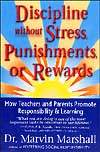
In his book Discipline without Stress, Punishments, or Rewards - How Teachers and Parents Promote Responsibility & Learning, he clearly and concisely demonstrates how the external approaches of relying on rules, imposing consequences, rewarding students for appropriate behavior, and punishing students to make them obey are all counterproductive.
The book can be purchased from the National Association of Elementary School Principals, the National Association of Secondary School Principals, the National School Boards Association, Phi Delta Kappa, at local bookstores, or from his website www.MarvinMarshall.com.
Click to visit Marvin Marshall's Homepage.
To read about the failings of punishments and rewards, go to
www.AboutDiscipline.com
Marvin Marshall is a professional speaker and seminar leader who presents his program, "Discipline without Stress, Punishments, or Rewards - Raise Responsibility and Promote Learning," to schools across the world.

 Promoting Learning...
by Dr. Marvin Marshall Curriculum, Instruction, Classroom Management, and Discipline
A well-known international journal recently published an interesting article entitled, "The Brilliant Inventiveness of Student Misbehavior: Test Your Classroom Management Skills." Good article--but misnamed! The article had nothing to do with classroom management. The article was entirely about discipline. Confused? So are many educators--even college professors. Not long ago when speaking at an international conference on character education, a college professor said to me, "I don't like the word 'discipline'; it's too harsh, so I use 'classroom management' instead." This teacher of teachers had not a clue to the differences. Last year, I was the distinguished lecturer at the conference of the Association of Teacher Educators (ATE). This is the association whose membership is primarily composed of university professors who teach methods and other educational courses. At my behest, the name of the Special Interest Group (SIG) was changed from "Classroom Management" to "Classroom Management and Discipline." Although related, these are distinctly different topics---and should not be lumped together as if they were synonymous. CLASSROOM MANAGEMENT deals with how things are done. DISCIPLINE deals with how people behave. CLASSROOM MANAGEMENT has to do with procedures, routines, and structure. DISCIPLINE is about impulse management and self-control. CLASSROOM MANAGEMENT is the teacher's responsibility. DISCIPLINE is the student's responsibility. CLASSROOM MANAGEMENT is enhanced when procedures are:
When procedures are learned, routines are established. Routines give structure to instruction. Good classroom management is essential for efficient teaching and learning. Chances are that when you walk into a room, you do not pay much attention to the floor. But if it were missing, you would. The analogy works for classroom management. You don't notice it when it is good. But without it, the lack of it is readily apparent. The differences between classroom management and discipline are two of the four distinctive concepts necessary for an understanding of effective teaching. The other two are "curriculum" and "instruction." Curriculum refers to what is to be taught. The curriculum is determined by state departments of education, boards of education, the "federal agenda," professional associations, the community--and, more recently, corporate performance accountability models for learning. It is the teacher's responsibility to make the curriculum relevant, interesting, meaningful, and/or enjoyable. (The November, 2002, article gives suggestions for accomplishing this task.) Instruction has two components: (1) teaching and (2) learning. The former refers to what the teacher does, the latter to what students do. Good teaching of a lesson has at least three parts: (1) grabbing interest, (2) the actual teaching, and (3) reflection on the experiences for enhanced understanding, reinforcement, and retention. Learning pertains to what students do to learn. Here is my point: If you have a particularly unsuccessful lesson, ask yourself, (1) Was it the curriculum? e.g., I just didn't make it appealing, or (2) Was it instruction? e.g., I had a wonderful lesson planned, but I did all the work; the students were not involved enough in their learning, or (3) Was it classroom management? e.g., I had a wonderful lesson, but it took 10 minutes to get everything organized, or (4) Was it a discipline problem? e.g., I prompted the students' curiosity, taught a good lesson with meaningful student activities, had everything organized, but I still had disruptions? Asking yourself these questions enhances a clear understanding of the differences between curriculum, instruction, classroom management, and discipline and is a fundamental first step of an effective teacher. Ideas for implementing the proactive (Covey), noncoercive (Glasser), collaborative and empowering (Deming) approach to reducing behavior problems is at http://www.MarvinMarshall.com /raise_responsibility.htm
Subscribe to the free monthly newsletter, PROMOTING RESPONSIBILITY, at http://www.DisciplineWithoutStress.com. Email Dr. Marshall: marvmarshall@teachers.net © Dr. Marvin Marshall, 2003. Questions submitted to Kathleen Carpenter at kathleen@teachers.net will be considered by Marv Marshall for responses in future monthly columns in the Teachers.Net Gazette.
Gazette Articles by Dr. Marshall:
Browse through the latest posts from the Classroom Discipline Chatboard...
|


